13 February, 2012

Sunny Brazil: Rio de Janeiro

After a few days spent in Cabo Frio, Sven and I left for our next target: Rio de Janeiro (or simply, "Rio"). The city everybody thinks of when you talk about Brazil: Samba, Sugar Loaf, Copacabana and Ipanema, Favelas and Drugs, Carnival and Plastic Surgery, and all watched by Christ the Redeemer. Cidade maravilhosa (Marvelous city), how its known, where beauty and chaos meet and the result is a unique sort of people, that are either loved or hated by other brazilians! For our German readers: It is the same with Berlin. Everybody outside of it hates it and is complaining about, but the people living there think it is special. But in the case of Rio this is really true!

It used to be the capital of Brazil for about two centuries until Brasilia was built a few decades ago. It's where one of the prettiest carnivals at the Marquês de Sapucaí take place, the beautiful new years fireworks at the Copacabana Beach happen and where Bossa Nova was created.

Coming from the direction of Niterói, we crossed the Rio-Niterói Bridge and from there we could have a blick on what would be ahead of us:


Ponte Rio-Niterói

Arriving at the city bus station, we took a cab to the hostel located at the Ipanema area, one of the best neighbourhoods in Rio. After checking in, we walked directly to the beach. And there at Praia de Ipanema, you can clearly see who's brazilian and who's a gringo (foreigner)!

                      the brazilian                            the "gringo" (obs: with tennis shoes)

Praia de Ipanema

For the next day, we booked a city tour with the hostel people that picked us up early in the morning and the first stop was at the Praia Vermelha ("Red beach") were the guy parked the van and we could hike half of the way up to the famous Pão de Açúcar (Sugarloaf). At the Sugarloaf, there are basically two mountains and the first one you can go up walking, although most of people prefer taking the cable car. The second part is not possible to be rached without taking the cable car! :)


So you can have an idea, the Sugarloaf's two mountains


             Praia Vermelha                Going up on the mountain 
                                                  (a danish belonged to the group)

A stop to drink some water before taking the 
cable car to the second mountain


View from up there: the beaches, Corcovado (Christ the 

Redeemer) and the Guanabara Bay at the right corner


After going down, we went back to the van and the guy drove us around the city center and the Lapa neighbourhood, in which the famous arches (an aqueduct) can be seen:

Arcos da Lapa and the cathedral in the back (the pyramid) 


At the Lapa neighbourhood, the tour guide took us to see the Escadaria Selarón, a world famous set of steps decorated with tiles of all kinds by a chilenian (Jorge Selarón) that decided to make a tribute to the brazilian people. There are tiles from everywhere and we found some from germany as well!


Escadaria Selarón


From the Escadaria Selarón, the guide drove us in the direction of the Christ the Redeemer. In the way to it, we could see one of the famous trams, popular known as the Bonde de Santa Tereza. It was so full that I was happy to be comfy inside of the van with air conditioning!


Parking the car just behind the Christ the Redeemer (Cristo Redentor), Sven met his good friend, the monkey that didn't feel like sharing his banana with him! 


Cristo Redentor


View of Ipanema and Leblon neighbourhoods 
and the Rodrigo de Freitas Lagoon


View of the Sugarloaf and the Guanabara Bay


The next day we visited other sightseeings around the city, including the beautiful Botanic Garden (Jardim Botânico) which makes you feel like spending hours just by contemplating it!


Sven discovered a new fruit: the "jaca" 


Walking around the Copacabana neighbourhood, we saw one of the many slums of Rio. To be honest, everybody talks a lot about the city violence and we had quite a nice time there, not having to be obsessed with security. I guess you just need to know where to go and where not to go and also keep your belongings closer to you always, not showing cameras off and other stuff too much. With those things in mind, I think it's quite ok, like any other big city.

Favela


Praia de Copacabana


Walking back to the hostel, a quick stop for a 
picture at Ipanema Beach in the evening

After three great days in Rio de Janeiro, it was already time to go back to Belo Horizonte, and we took the bus back for another 10-hour journey. Although long, it was quite comfy!  


If you would like to see a bit more of Rio, there's a small video, I hope you can enjoy it!


12 February, 2012

Sunny Brazil: Cabo Frio

Olá amigos,

this time I have been condemned to write the next post about Brazil. The second visit to BH (Dec 2008) we decided to take a beach holiday and have a look at the most famous city of Brazil. So we first went from BH to Cabo Frio, a small beach front city almost 600km south from BH. Although my Portuguese book says that distances around 500km are still seen as short range.


We took one of the long range buses, comparable to the ones Germans use to go to Lorett de Mar in Spain. You don't have trains in Brazil, as the automotive industry had already to much influence on the government when the decision was made. Nevertheless the trip is quite comfy, at least as long the bus driver did not switch off the air condition during the night, just a little bit long with around 10 hours. But it was worth the ride...


These are the views from our flat from the morning to evening. 


Cabo Frio (Cold Cape, in English) itself is a 190.000 inhabitant town situated at the state of Rio de Janeiro. It’s a famous get away for lots of people, especially the ones coming from Minas Gerais (that, in most cases, own flats there), during summer time and long holidays. Additionally it is said that during these times, half of Minas Gerais is in Cabo Frio and it is easier to meet someone from BH there than in the City. Therefore, it’s one of these places where it can be quite empty with the lack of visitors during the low season. 


There are nine beaches in Cabo Frio but the main one is called Forte Beach (praia do Forte), named after the fort (Forte de São Mateus) situated in the north rock, built by the Portuguese in 1616 to defend themselves from the French, English and Dutch, that sought pau-brasil, a very desired kind of tree at the time (“Brazil” is named after this species of tree). Anyways, the Forte Beach has 4 km of clean white sand and the ocean water is reaaaally cold! 


Forte Beach - The promenade in the evening

 it was also Christmas time!

Forte de São Mateus


The neighbour village is called Arraial do Cabo and some of the beaches are even prettier than the ones at Cabo Frio. We took the bus and were there in no time. It’s great to spend the day, there were not many tourists when we’ve been there, so we could enjoy the quietness, Sven could enjoy the peace by reading a book and Mitza by trying to get a tan. We enjoyed the opportunity to eat a delicious meal: Fish and chips! Sorry, but this is much better than the ones made in London! :)


Hmmm, Coconut water!


Yachting in Brazil


Fish and Chips, Brazilian style!


"Buggy" - a typical beach car - look at the seats!
 (As soon as the owner noticed that I took a picture he tried to sell it to me!)


After spending a few lovely days in Cabo Frio and region, we headed south, to Rio de Janeiro (city), which you can read about on our next post!


01 February, 2012

Back to the future

Oi mates,

although folks seem to like posts about past holidays in Brazil more, I will still interrupt the flow and post something about London again. Probably my former Portuguese teacher was right, that Brazilians are sometimes are like (average) Americans and are not so fond of looking beyond there own great country? Lets see if I can provoke some reactions with my bold statement! :)

As all mega-cities London is fighting against traffic congestion in general and pollution in particular, employing hybrid buses, promoting commuting by bike by the introduction of "cycle superhighways" and short term rent bike stations, and the creation of a congestion zone, where you have to pay an extra fee when entering. 

Another weapon used against fuel waste is the G-Wiz electric car:

Boy is this car ugly. And no, the picture is not somehow deformed, the car really looks like this! So with all the advantages it might offer in the city, like public chargers over London, it is still no ride to impress in front of your favorite night club. Here in Stratford they probably would chop of the roof and make a supermarket cart out of it! Although the shopping trolley we got lately offers more loading capacity... 

But, don't worry you environmental-friendly pimp, a solution is on the way: The electric Mini - Hummer!
Sorry for the low quality, but just had my mobile with me, and due to my long working hours *ahem* it was already dark, but we are also addressing this issue. But anyways, the company offers MEV offers 2 more versions, one more ridiculous than the other! I did not find out if they are allowed to go on the normal road, I just hope this is not the design of our future mobility!

31 January, 2012

Sunny Brazil: Ouro Preto and Lavras Novas


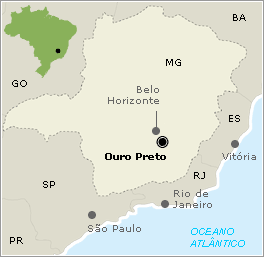
Ok, so I know this trip happened in 2008 or 2009 but it’s worth remembering (specially cause I found old pics on the computer recently). Well, this post is about Ouro Preto and Lavas Novas (a small village located in the district of Ouro Preto), both located in Minas Gerais, Brazil.


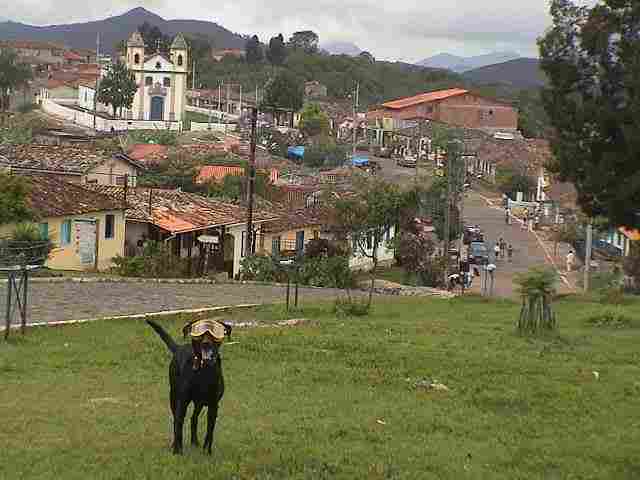
We started our journey in Belo Horizonte (BH) and drove around 120Km to Lavras Novas to spend a couple of days in a very romantic way. The trip takes place in the asphalt most of the way, but as the village is really small (around 1.500 inhabitants) and quite hidden in between the mountains, the last kilometres were driven on a dirt road. There was a quite weird wood bridge on the way and when you pass the car over it, you have the impression it will fall apart due to the noise. The landscape is pretty and with many huge rocks along the road, which makes one scared when he thinks that it might have rolled from up there!  

Road to Lavras Novas

 Lavras Novas

We chose a special Inn called Palavras Novas which is decorated in a rustic style, something quite typical in the State of Minas Gerais. As it was in the middle of the week, the Inn was almost empty and we ended up enjoying our day in the pool by ourselves watching the (fast) sunset. Sunsets in Brazil are quite a disappointment for Europeans, as it takes only a few minutes until the sun sets down completely and it’s then suddenly dark. We had then a tea offered by the Inn with all sorts of cakes, breads and cookies. The evening was great, nice food, no noise, fresh and pure air, no city lights could be seen out of the window, only the stars... So, more romantic than that, forget about it! To tell you the truth, our stay at the Inn was so delightful, and as we didn’t have much time during the next day, we didn’t get to see much of the village or the region’s famous waterfalls. So on the next morning we left Lavras Novas and put ourselves on the way to Ouro Preto, only 17Km away.


At the Inn


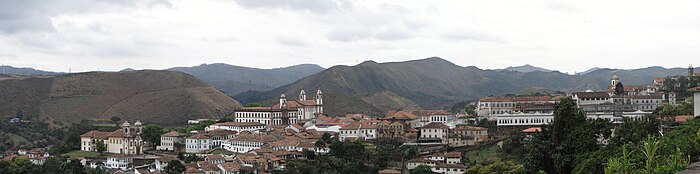
Ouro Preto (in English, Black Gold) is a former colonial mining town located in the so called “Serra do Espinhaçmountains and designated a World Heritage Site by UNESCO because of its baroque architecture. It was founded at the end of the 17th century and originally called Vila Rica ("rich village"). It was the focal point of the gold rush of Brazil's golden age in the 18th century. It was also the scenario for an unsuccessful Brazilian Independence Movement, as the country was a colony of Portugal at the time. It was the capital of Minas Gerais from 1720 until 1897, when the needs of government outgrew this town in the valley and the state government was moved to the new, planned city of Belo Horizonte, as I mentioned on a previous post.


Ouro Preto

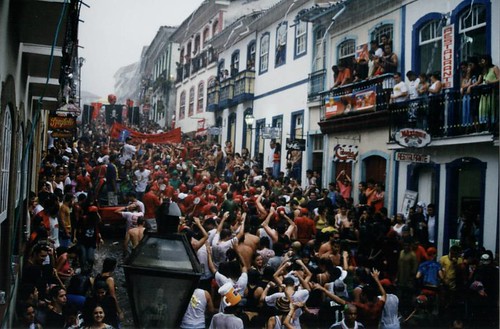
There’s a big university in Ouro Preto and for this reason, there are over 10.000 students living there and they make life in town something else. There are several fraternity houses called "repúblicas", each one of them with their sets of rules, traditions, and of course, great parties during religious holidays and Carnival. 

Carnival in Ouro Preto

But now back to our trip. We parked the car at the main Square (Praça Tiradentes) and decided to walk around it and get to see the main attractions, which include several churches richly decorated with gold, sculptures and paintings; the main museum (Museu da Inconfidência); the entrance of a Gold Mine; saw a jeweller shaping the beautiful stones; visted the old theatre, the former House of Gold rendering and coin-making (Casa dos Contos) and the beautiful houses of the “Rua Direita” (street)  Of course, to visit all those places, we had to go up and down the many hills, which made Sven sweet like a waterfall – as you can totally imagine!

Museu da Inconfidência and Praça Tiradentes (Square)

Igreja de São Francisco de Assis

Sven in the Balcony of the "Casa dos Contos"


In the end, we got tired of climbing the hills to see the remaining one thousand of churches and decided to return to BH. I hope you’ve enjoyed reading this post! For more information about Ouro Preto, please visit: http://ouropreto.travel/en or watch the video:


25 January, 2012

Sunny Brazil: Belo Horizonte - Pampulha

Pampulha is a region located in the northern part of Belo Horizonte with an artificial lagoon with the same name (Lagoa da Pampulha) The lagoon and the beautiful buildings in the area are one of the most important tourist attractions in BH.   

Pampulha Lagoon

The famous architect Oscar Niemeyer was the chosen person to make the project for a set of buildings in 1940 and the result was so good that it soon became a reference for the Modern Brazilian Architecture (He was also the responsible one for the planning of Brasilia, Brazil’s capital). The set of buildings include the São Francisco de Assis Church, the Museum of Modern Art (former Casino), the Ball House and the Yacht Club. The beautiful gardens, paintings and the sculptures add a unique touch to the whole set.


S
ã
o Francisco de Assis Church


Museum of Modern Art


Ball House ("Casa do Baile")

Yacht Club

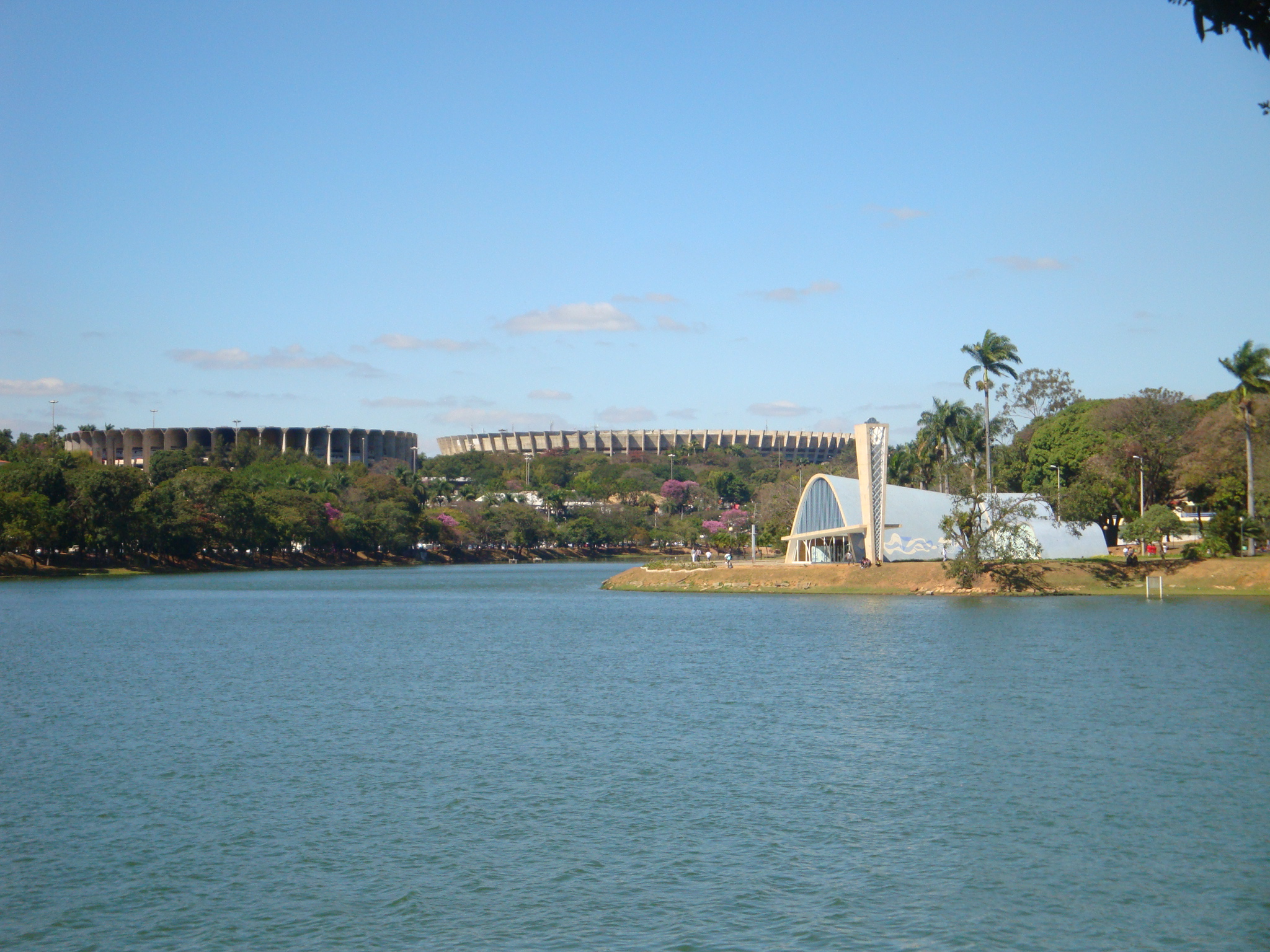
Around the Lagoon there are also some other important landmarks such as the Soccer Stadium (Estádio Governador Magalhães Pinto) known as “Mineirão” and the Stadium/Concert Hall (Estadio Jornalista Felipe Drummond) known as “Mineirinho”, Very important observation: the “Mineirão” is being refurbished to host some of the World Cup 2014 soccer games. An important note, so you can already start to plan your holidays here around this time!  

Mineirinho (small, on the left) and Mineirão (the big one)


Driving the car, running or riding the bike around the Lagoon, the person also get to see the Zoo and the Guanabara Park. Ah, talking about running, there’s a famous annual running competition called “Volta Internacional da Pampulha and people come from all around the world to compete. I almost forgot to say: when you're walking quietly around the lagoon, be aware of the alligator, it lives in the lagoon for a while and appears out of nowhere from time to time; not to mention the capybaras that also love to make an exhibition!

      
         Capybaras (Wasserschweine)                                      Alligator


Every New Year’s Eve there are many people gathered at the Pampulha Lagoon to celebrate and to see the fireworks! Lots of them stand up on the roof terrace of their fancy homes to watch it and welcome the brand new year.

I hope you’ve enjoyed reading! ‘Till next post!

Map of the Pampulha Lagoon Area

Mineirinho, Mineirão,  São Francisco de Assis Church and the Lagoon